

Quick facts: UNESCO World Heritage Site | Siem Reap Province, Cambodia | 400+ sq km | Built 9th–15th century | Recommended stay: 2–4 days | Entrance fee: $37/day (1-day pass)
If you’ve ever Googled “best temples in the world” and ended up three hours deep in a rabbit hole of sunrise photos and crumbling stone corridors — congratulations, you’ve already met Angkor.
This isn’t just a temple. It’s an entire ancient city. A civilization’s greatest flex, frozen in stone and slowly being reclaimed by jungle. And honestly? No photograph, travel blog, or Instagram reel does it justice. You have to go.
Here’s everything you need to know before you do.
Why Visit Angkor Archaeological Park?
Let’s get the obvious out of the way first. Angkor Archaeological Park isn’t just “a nice heritage site.” It’s the largest pre-industrial urban complex ever discovered — home to hundreds of temples, vast hydraulic networks, and the remnants of a city that, at its peak, may have housed over a million people. For context: medieval London had maybe 80,000.
The Khmer Empire built this place between the 9th and 15th centuries, and what they left behind is staggering. We’re talking intricate sandstone carvings that took decades to complete. Temple moats so large they look like lakes. Faces carved into towers that stare you down from every angle.
UNESCO listed it as a World Heritage Site in 1992 — not because it needed the publicity, but because it genuinely needed the protection.
Angkor isn’t just history. It’s a reckoning. You walk through it and think: how? How did people without cranes, trucks, or GPS build something this precise? This massive? This beautiful?
That question alone is worth the flight to Cambodia.
A Brief History of Angkor
The Rise of the Khmer Empire
The Khmer Empire emerged in the early 9th century when King Jayavarman II declared himself a “god-king” — devaraja — and unified the region’s fragmented kingdoms. He set up court near Phnom Kulen, north of what would become Angkor, and essentially said: watch what we build.
The empire expanded rapidly, dominating much of mainland Southeast Asia. At its height, Khmer territory covered modern-day Cambodia, Thailand, Laos, and Vietnam. The capital moved several times before settling in the Angkor region, where it would remain for centuries.
The Golden Age
The 10th through 13th centuries were Angkor’s golden age. King Suryavarman II commissioned Angkor Wat in the early 12th century — a project so ambitious it reportedly took 30-plus years and tens of thousands of workers. His successor, Jayavarman VII, pushed even further, building Angkor Thom, the Bayon, Ta Prohm, and Preah Khan in a construction boom that practically defined the skyline of ancient Southeast Asia.
This was also when Angkor’s sophisticated hydraulic system — a network of reservoirs, canals, and moats — made large-scale agriculture possible in a region with brutal dry seasons. Engineering as statecraft. These people knew what they were doing.
Decline and Abandonment
Here’s the part they don’t always put on the brochures. By the 15th century, Angkor was in trouble. Repeated Thai sieges. Political instability. A hydraulic system stretched beyond its capacity. The capital eventually shifted south toward Phnom Penh, and Angkor was gradually abandoned — though it was never entirely forgotten. Buddhist monks maintained some temples for centuries.
Rediscovery and Restoration
The French “discovered” Angkor in the 1860s — though Cambodians never lost track of it, which is worth noting. French naturalist Henri Mouhot’s published accounts brought Angkor to Western attention, and a long era of restoration began. That work continues today, led by APSARA (the Authority for the Protection and Management of Angkor), with international collaboration from France, Japan, India, and others.
Top Temples to Visit in Angkor Archaeological Park
Angkor has over a thousand temples spread across 400+ square kilometers. You can’t see them all. You shouldn’t try. But here are the ones that genuinely earn their reputation.
Angkor Wat
The one everyone comes for — and it earns every bit of the hype. Angkor Wat is the world’s largest religious monument, built by Suryavarman II in the early 12th century as a Hindu temple dedicated to Vishnu. It was later converted to Buddhism and has functioned as a Buddhist temple continuously ever since.
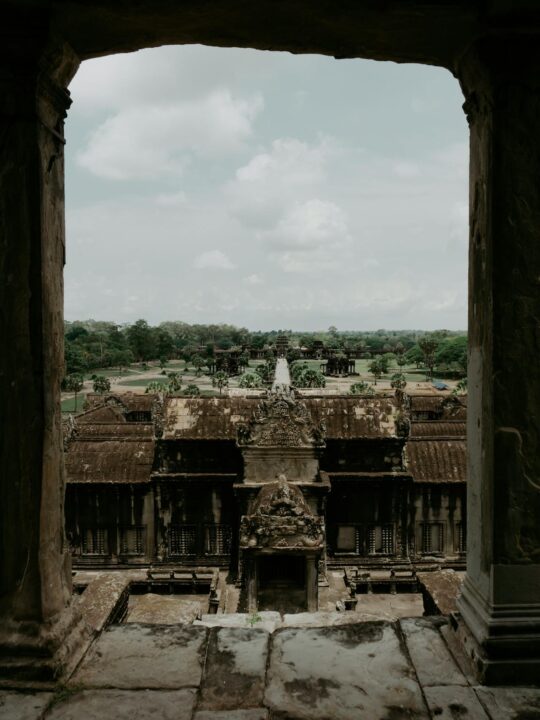
The architectural scale is absurd. The central tower rises 65 meters. The outer enclosure measures 1.5 km by 1.3 km. The bas-reliefs on the gallery walls stretch for over 800 meters and depict battle scenes, mythological stories, and the 37 heavens and 32 hells of Hindu cosmology in astonishing detail.
Sunrise here is the stuff of bucket lists. You’re not alone — there will be crowds — but when the reflection of those five towers appears in the western moat at dawn, you’ll understand why everyone makes the trip.
Visitor tips: Arrive by 5:15 AM for sunrise. Dress modestly (shoulders and knees covered — seriously, they will turn you away). Budget at least 2–3 hours. Hire a guide. The carvings tell stories that reward explanation.
Bayon Temple
If Angkor Wat is the headliner, Bayon is the one you’ll talk about for years. Located at the center of Angkor Thom, Bayon is a 12th-century temple commissioned by Jayavarman VII — arguably the most prolific builder the Khmer Empire ever produced.
What sets Bayon apart are the 54 towers, each carved with massive four-faced smiling heads. Over 200 faces in total, staring serenely outward from every direction. Walk through the upper terrace and you’ll find yourself making eye contact with enormous stone faces at every turn. It’s surreal. It’s magnificent. It’s slightly eerie in the best possible way.
The bas-reliefs here are different too — less mythological than Angkor Wat’s, more documentary. You see Khmer soldiers marching to war, fish markets, cockfights, women giving birth. Daily life from 800 years ago.
Tip: Visit in the late afternoon when the light goes golden and the crowds thin out.
Ta Prohm
This is the “Tomb Raider temple.” Yes, Angelina Jolie filmed here in 2001. No, that’s not the most interesting thing about it. What is interesting is that APSARA and UNESCO made a deliberate decision to leave this temple largely as it was found — with massive strangler fig and silk-cotton trees growing directly through and over the structures.
The result is simultaneously haunting and beautiful. Root systems the size of cars draped over stone doorways. Trees growing through walls. Nature and architecture in a slow, centuries-long embrace.
Ta Prohm was built in the late 12th century by Jayavarman VII as a Buddhist monastery and university — it reportedly housed over 12,000 people at its peak. Today it’s one of the most atmospheric sites in the entire park.
Tip: Go early or late. The midday crowds are brutal, and the narrow passages feel claustrophobic when they’re packed.
Angkor Thom
Most visitors think of Angkor Thom as the “city around Bayon,” but that undersells it enormously. Angkor Thom was the last capital of the Khmer Empire — a walled city covering 9 square kilometers, entered through five monumental gateways flanked by rows of giant stone figures pulling a giant naga (serpent).
The south gate is the most photographed, and for good reason. The two rows of devas and asuras engaged in the cosmic “churning of the sea of milk” stretch 50 figures on each side. The gateway tower rises 23 meters. It’s a statement entrance.
Inside Angkor Thom, beyond Bayon, you’ll find the Baphuon temple (a restored 11th-century pyramid), the Elephant Terrace, the Terrace of the Leper King, and several smaller temples. You could spend a full day here.
Banteay Srei
Far from the main circuit — but worth every extra kilometer. Banteay Srei is a 10th-century temple dedicated to Shiva, built mostly from pinkish-red sandstone and famous for its extraordinarily detailed carvings. Where most Angkor temples go big, Banteay Srei goes intricate. The lintel carvings are some of the finest examples of Khmer art ever produced.
It’s smaller than the main temples, but the craftsmanship is in a different league. The nickname translates roughly to “Citadel of Women” — some say because only female hands could have carved something so delicate.
Located about 25 km north of Angkor Wat, most people visit by tuk-tuk or private car. Add it to your itinerary if you have three or more days.
Preah Khan
Preah Khan doesn’t get the Instagram traffic of Ta Prohm, but it arguably deserves to. Another massive Jayavarman VII project, Preah Khan was built as both a Buddhist temple and a functioning city — it reportedly housed over 1,000 teachers. It’s less restored than Ta Prohm, which means more genuine jungle atmosphere and fewer selfie sticks.
The long axial galleries, the Hall of Dancers with its beautiful apsara carvings, and the two-story circular structure (whose purpose is still debated) make Preah Khan a fascinating half-day.
Best Things to Do at Angkor
1. Watch Sunrise at Angkor Wat
Yes, every guide tells you to do this. Do it anyway. Set your alarm for 4:45 AM, grab coffee from the vendors outside the gate, walk to the reflecting pool, and wait. When the sky turns pink and orange behind those five towers, you’ll understand why millions of people make this exact journey every year.
2. Get Lost in Bayon’s Faces
Give yourself time without an agenda here. Wander the upper terrace. Let yourself be watched by 200 stone faces. There’s no right way to experience it.
3. Explore the Jungle Temples
Ta Prohm is the famous one, but Beng Mealea (about 70 km east) takes it further — largely unrestored, no walkways, just you and your guide climbing through a collapsed temple being swallowed by jungle. It’s an Indiana Jones fever dream.
4. Photograph the Ancient Carvings
Bring a decent camera and slow down. The bas-reliefs at Angkor Wat alone could occupy a serious photographer for an entire day. Look for the detail: the warrior’s expression, the fish jumping in the battle scene’s water, the celestial dancers (apsaras) with their intricate jewelry.
5. Cycle Through the Park
The main temples are spread out but connected by good roads. Renting a bicycle and cycling the Small Circuit (17 km) at your own pace is one of the genuinely underrated ways to experience Angkor. Early morning cycling through jungle paths with temples emerging through the trees? That’s the stuff.
6. Learn Khmer History Properly
Hire a licensed APSARA guide. Not because you can’t read the signs yourself, but because the stories behind the carvings, the political context, the construction techniques — all of it becomes ten times richer with someone who actually knows the history. Budget around $25–40 for a full day.
7. Join a Guided Sunrise Tour
If going solo to sunrise feels overwhelming, plenty of tour operators in Siem Reap run small-group sunrise tours that include transport, breakfast, and a guide. It’s an easier way to ensure you’re at the right spot at the right time.
Angkor Archaeological Park Map
The Small Circuit
The classic one-day loop. Covers Angkor Wat, Angkor Thom (including Bayon, Baphuon, the Terraces), Ta Prohm, and Banteay Kdei. About 17 km if you’re cycling, manageable by tuk-tuk in half a day.
The Grand Circuit
Adds Preah Khan, Neak Pean, Ta Som, and the East Mebon. A full day for serious temple-goers. About 26 km by bike.
The Extended Circuit
For the obsessive. Adds Banteay Srei, Kbal Spean, and Beng Mealea — the outer temples that require transport beyond the main circuits. Best spread across a multi-day visit.
Best Time to Visit Angkor
| Month | Weather | Recommendation |
|---|---|---|
| November–February | Cool and dry, 20–28°C | Best — peak season |
| March–May | Hot and dry, 32–40°C | Good, but exhausting midday |
| June–October | Green season, some rain | Lush and atmospheric, fewer crowds |
My honest take: November to February is peak season for a reason — the weather is genuinely pleasant, and the light is beautiful. But if you go in October, the moats are full, the jungle is electric green, and you’ll share the temples with far fewer people. Bring waterproof sandals and lean into it.
How Many Days Do You Need at Angkor?
One Day
Possible, but not ideal. You’ll see Angkor Wat (sunrise), Bayon, Ta Prohm, and maybe Angkor Thom’s gate. Tick-the-boxes tourism. If it’s all you have, make it count.
Two Days
The sweet spot for most visitors. Day one: sunrise at Angkor Wat, then the Small Circuit. Day two: Angkor Thom properly (not just Bayon), Preah Khan, Neak Pean. You’ll leave satisfied.
Three Days
The ideal Angkor experience. Add Banteay Srei on day three, spend real time at each temple, cycle instead of rushing, eat lunch in the shade with zero guilt. This is how you should do it.
Four Days or More
For the genuinely obsessed — add Beng Mealea, Kbal Spean (a river with carved linga), Roluos Group (early Angkor temples rarely visited), or just revisit your favorites at different times of day. Sunset at Angkor Wat hits differently than sunrise.
Angkor Ticket Information
Tickets are purchased at the official APSARA ticket office, about 4 km from Angkor Wat. You cannot buy them at the temple gates.
Current pricing (2026):
- 1-day pass: $37
- 3-day pass: $62 (valid over any 3 days within a 10-day window)
- 7-day pass: $72 (valid over any 7 days within a month)
Passes include a biometric photo taken at the ticket office — they do check. Children under 12 enter free. Tickets are not refundable.
Buy early. The ticket office opens at 5 AM (so you can buy before sunrise). You can also buy the previous evening for the next morning’s visit.
Photography Guide at Angkor
Best Sunrise Spots
- The reflecting pool at Angkor Wat — the classic. Face west toward the main towers.
- The upper terrace of Angkor Wat — if it opens early enough, the elevated view is worth it.
- Srah Srang reservoir — a quieter option a short tuk-tuk ride from Angkor Wat.
Best Sunset Spots
- Phnom Bakheng — the hilltop temple with panoramic views. Arrive 90 minutes early; they cap visitor numbers.
- Pre Rup — another hilltop temple with great elevation and fewer crowds than Bakheng.
- The West Baray — a massive reservoir that turns golden at dusk.
Drone Regulations
Drone flying is strictly prohibited in Angkor Archaeological Park without official APSARA permission, which is rarely granted to tourists. Don’t try it.
Temple Photography Tips
- Shoot in golden hour (6–8 AM, 4–6 PM). Midday light is harsh and flat.
- Use a wide-angle lens for temples, a longer lens for carved detail.
- The bas-reliefs photograph best with raking sidelight — early morning is ideal.
- Ask before photographing monks or locals. Most are happy, but ask first.
Visitor Tips
What to Wear
Dress code is enforced, and it’s not negotiable. Shoulders must be covered. Knees must be covered. This applies to all temples. Keep a light scarf or sarong in your bag — you’ll thank yourself when you forget your long pants. Open-toed shoes are fine; you’ll be removing them constantly to enter temple interiors.
Temple Etiquette
Remove shoes before entering temple sanctuaries. Don’t climb on any structures (this was recently more strictly enforced — several areas where tourists could previously climb are now off-limits). Don’t touch the carvings. Don’t be the person who ruins the moment for everyone.
Staying Hydrated
It’s Cambodia. It’s hot. Bring water everywhere, drink it constantly, and eat salty snacks to replace what you sweat out. The vendors inside the park sell water and coconuts; buy them. Heatstroke at Angkor is genuinely a thing that happens to tourists who underestimate it.
Transportation Options
Tuk-tuk is the classic choice — flexible, fun, and your driver waits for you. Agree on a full-day price upfront (around $15–20 for the Small Circuit). Bicycle is great for fit, early risers who want freedom. Private car is worth it for Banteay Srei and the outer temples. E-bikes are increasingly available and a good middle ground.
Hiring Guides
APSARA-licensed guides are stationed at the main temples and are available through your guesthouse or tour operator in Siem Reap. A full-day guide for one group runs $25–40 depending on experience. For Angkor Wat specifically, a guide transforms the visit from looking at pretty carvings to actually understanding what you’re seeing. Do it at least once.
Where to Stay Near Angkor
Luxury Hotels
Siem Reap has some genuinely spectacular luxury stays. Amansara is widely considered the finest — small, intimate, impeccably designed, with an Aman price tag to match. Raffles Grand Hotel d’Angkor in Siem Reap town is a gorgeous colonial-era property. Park Hyatt Siem Reap is a more modern option with excellent service.
Mid-Range Hotels
The Heritage Suites Hotel punches above its price point. Viroth’s Hotel is a local gem with a great pool and fantastic reviews. Siddharta Boutique Hotel is central, stylish, and well priced.
Budget Hotels
The guesthouse scene around the Old Market area in Siem Reap is dense and competitive. Mad Monkey Hostel, Onederz Hostel, and dozens of similar guesthouses offer clean rooms, social vibes, and tuk-tuk connections for under $25/night.
Family-Friendly Hotels
Sofitel Angkor Phokeethra Golf & Spa Resort has a huge pool and family rooms. Victoria Angkor Resort is another solid option with kid-friendly facilities within easy reach of the temples.
Nearby Attractions
Angkor is the main event, but Siem Reap province has more to offer than most visitors realize.
Siem Reap Town has evolved dramatically. Beyond the temple fatigue, you’ve got a lively food scene, Khmer cooking classes, the Artisans Angkor craft workshops, and the Phare Circus — a spectacular show run by a Cambodian NGO.
Tonlé Sap Lake is one of Southeast Asia’s most important freshwater ecosystems — a lake that reverses flow direction with the seasons and swells to six times its dry-season size. The floating villages here are genuinely extraordinary.
Phnom Kulen National Park is where the Khmer Empire essentially began. Waterfalls, a massive reclining Buddha, and the Kbal Spean river with hundreds of carved linga (sacred Shiva symbols) in its bed.
Beng Mealea is 70 km east and radically undervisited. An 11th-century temple that’s essentially been left to the jungle, with no walkways and very few tourists. If Ta Prohm felt too tamed, this is the rawer version.
Frequently Asked Questions
Is Angkor Wat the same as Angkor Archaeological Park?
No, though it’s an extremely common confusion. Angkor Wat is a single temple — the most famous one — within the much larger Angkor Archaeological Park, which spans over 400 square kilometers and contains hundreds of temples, ancient city sites, and water management structures.
How much time do you need at Angkor?
Two to three days gives most visitors a satisfying experience. One day is possible but rushed. Four or more days is ideal if you want to go deep.
Is Angkor worth visiting?
This is not a serious question. Yes. Unambiguously, one of the most extraordinary places on earth.
Can you visit Angkor without a guide?
Yes — the temples are accessible independently and signage has improved significantly. But hiring a guide at least for Angkor Wat transforms the experience. The depth of history in those carvings deserves explanation.
What is the best temple besides Angkor Wat?
Bayon, for most visitors. Ta Prohm for atmosphere. Banteay Srei for artistry. Preah Khan for scope without crowds. Ask ten travelers and you’ll get ten different answers.
What should I wear when visiting Angkor?
Lightweight, breathable clothing that covers shoulders and knees. Long linen pants are popular for a reason — they’re cool and pass the dress code. Closed or easily removable shoes are useful.
Is Angkor suitable for children?
Yes, with caveats. The main temples are accessible, but the heat is intense, the walking distances are significant, and the historical context mostly goes over young children’s heads. Kids who like adventure, climbing (carefully), and exploring will love the jungle temples. Toddlers in prams: much harder.
What is the entrance fee for Angkor?
A 1-day pass costs $37, a 3-day pass costs $62, and a 7-day pass costs $72. Children under 12 enter free.
When does Angkor open?
The park opens at 5:00 AM (allowing visitors in time for sunrise at Angkor Wat) and closes at 6:00 PM. Individual temples may have shorter hours.
Can you visit Angkor at night?
Angkor Wat offers special evening access on select evenings. The main complex is otherwise closed after sunset. Watch for special event access programs.
What is the best way to get to Angkor from Siem Reap?
Tuk-tuk from Siem Reap town. The main entrance is about 5 km from the town center. Most guesthouses can arrange one for you; your driver waits while you explore.
Is there food available inside the park?
Yes — vendors and basic restaurants operate near the major temples, particularly Angkor Wat and Ta Prohm. But options are limited and pricey. A packed lunch from town isn’t a bad idea.
How far apart are the temples?
The Small Circuit covers about 17 km. The Grand Circuit about 26 km. Banteay Srei is 25 km from the main complex. A tuk-tuk driver handles all of this easily in a day.
Is it safe to visit Angkor?
Yes. Siem Reap is extremely safe by regional standards and very well set up for tourism. The main risks are heat, sunburn, and dehydration — not crime.
What language do they speak in Cambodia?
Khmer is the official language. In Siem Reap, you will be fine in English — it’s widely spoken in the tourism industry.
Is there a best time to visit Angkor Wat specifically?
Sunrise (5:30–7:00 AM) and late afternoon (4:00–6:00 PM) offer the best light and atmosphere. Midday is hot, bright, and busy. The temple is open all day, but timing changes the experience significantly.
Can I photograph the monks at Angkor?
You can ask, and most monks will agree to a photo. But ask first, be respectful, and don’t treat them as props. If they say no, accept it graciously.
Angkor Archaeological Park is managed by APSARA Authority. For official entry information, visit the Angkor Enterprise ticketing website.