

| Quick Facts | Details |
|---|---|
| UNESCO Status | UNESCO World Heritage Site (since 1991) |
| Location | Central Java, Indonesia |
| Built | 8th–9th Century CE |
| Dynasty | Syailendra Dynasty |
| Main Components | Borobudur, Mendut & Pawon Temples |
| Recommended Visit | Half Day to Full Day |
| Nearest Airport | Yogyakarta International Airport (YIA) |
| Best Time to Visit | May–September (dry season) |
There are places in the world that humble you. Not in a polite, brochure-copy way — but in the kind of way that makes you stop mid-sentence and go quiet.
Borobudur is one of those places.
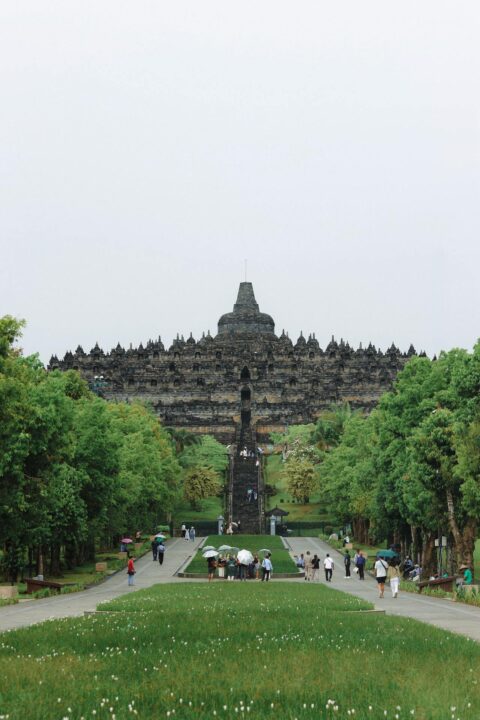
Rising from the lush plains of Central Java, surrounded by volcanoes that look almost theatrical, this 1,200-year-old Buddhist monument is the largest of its kind anywhere on earth. Not largest in Southeast Asia. Not largest outside Asia. The largest. Period.
And yet, somehow, it still flies a little under the radar compared to the Angkor Wats and Taj Mahals of the world. Which, honestly? Makes visiting it even better.
Whether you’re a history nerd, a photographer hunting light, or someone who simply wants to stand somewhere extraordinary and feel small — Borobudur delivers. Here’s everything you need to know before you go.
Why Visit Borobudur Temple Compounds?
Let’s be honest: there’s no shortage of temples in Southeast Asia. So why make the effort for this one?
Because Borobudur isn’t just a temple. It’s a mountain of stone that someone decided to carve into a cosmological map of the Buddhist universe. That’s not hyperbole — that’s actually what it is.
The Largest Buddhist Monument in the World
Size matters here, and not in a cheap superlative kind of way. Borobudur contains more than 2,500 square metres of relief carvings and 504 Buddha statues arranged across nine stacked platforms. The sheer scale of human ambition embedded in this structure is staggering.
The monument covers roughly 123 x 123 metres at its base. It took an estimated 75 years and tens of thousands of workers to build — using no mortar, no cement, just interlocking volcanic stone. In the 8th century. Without cranes. Think about that for a second.
UNESCO World Heritage Significance
Borobudur was inscribed as a UNESCO World Heritage Site in 1991, and it shares that designation with its two companion temples, Mendut and Pawon, as the Borobudur Temple Compounds. UNESCO calls it one of the greatest Buddhist monuments in the world, and for once, the institutional language isn’t overselling things.
The recognition came after a remarkable UNESCO-led restoration project in the 1970s that took nearly a decade, dismantled over a million stones, added a drainage system, and reassembled the whole thing. The fact that it stands so magnificently today is itself a story worth knowing.
Extraordinary Stone Reliefs
Walk the galleries and you’re essentially reading a stone comic book — except the panels tell stories from the Jataka tales (past lives of the Buddha), Buddhist cosmology, and daily Javanese life from over a millennium ago. Ships, musicians, dancers, royalty, demons. It’s all there.
There are 2,672 individual relief panels across the monument. If you laid them end to end, they’d stretch about 6 kilometres. No other Buddhist monument on earth has anything close to this narrative density.
Sunrise and Cultural Experiences
Then there’s sunrise, which has become something of a pilgrimage in itself. Arriving before dawn, climbing in the dark, and watching the sun emerge over the volcanic horizon while mist rolls through the rice paddies below — it’s one of those travel experiences that justifies the early alarm. More on the logistics of that later.
History of Borobudur Temple Compounds
You can visit Borobudur and think it’s beautiful without knowing any of its history. But knowing the history makes it devastating in the best way.
Construction During the Syailendra Dynasty
Borobudur was built between roughly 750 and 850 CE under the Syailendra Dynasty, a powerful Buddhist kingdom that ruled Central Java during that period. The dynasty was notable for being enthusiastically Buddhist in a region that also had strong Hindu traditions — which explains why the nearby Prambanan temple complex (also UNESCO-listed, also magnificent) is Hindu, and built almost contemporaneously.
The construction method was extraordinary: millions of pieces of volcanic andesite stone, quarried and transported from nearby riverbeds, fitted together in interlocking courses without a single drop of mortar. The whole structure is essentially a dry-stone puzzle at colossal scale.
Who exactly commissioned it, and precisely when, remains debated among scholars. But the architectural sophistication — the drainage systems built into the foundation, the symbolic geometry of the layout, the coherent iconographic programme across thousands of relief panels — suggests a highly organised and well-funded building operation.
Abandonment and Rediscovery
Here’s the part that makes the whole story more poignant: sometime around the 10th century, Borobudur was abandoned. Why exactly? Nobody knows for certain. A volcanic eruption from nearby Mount Merapi may have buried it under ash and driven the population away. A shift in political and religious power toward East Java is another theory. Possibly both.
For roughly eight centuries, the monument sat beneath jungle and volcanic debris, essentially forgotten. Local villagers knew of it — and there are accounts of it being used informally as a site of veneration — but it was not the grand pilgrimage centre it had once been.
It was Sir Thomas Stamford Raffles, then Lieutenant-Governor of Java under British colonial rule, who ordered a proper excavation in 1814. His surveyor, H.C. Cornelius, hacked through the vegetation and uncovered what lay beneath. The word “discovered” is a bit of a stretch — locals knew it was there — but it was Raffles who brought it to the attention of the wider world.
The 19th century saw various attempts at clearing, cataloguing, and (unfortunately) some fairly enthusiastic souvenir-collecting by colonial officials. King Chulalongkorn of Siam famously received eight crates of Borobudur artifacts as a gift during an 1896 visit. These are now in Bangkok.
The UNESCO Restoration Project
The real turning point came in the 20th century. A Dutch-led restoration in the 1900s stabilised much of the structure, but by the 1960s it was clear that more drastic intervention was needed. The monument was sinking. Vegetation was growing between the stones. Water was getting in.
Between 1975 and 1982, UNESCO coordinated a massive international restoration effort involving dozens of countries. More than 1,300,000 stones were numbered, removed, cleaned, treated, and reassembled. New foundations were added. Hidden drainage channels were installed. It was, by any measure, one of the most ambitious conservation projects in history.
Borobudur was inscribed on the UNESCO World Heritage List in 1991, nine years after the restoration was completed.
Understanding the Borobudur Temple Layout
This is the section that most travel guides skip, and honestly, it’s the most interesting part.
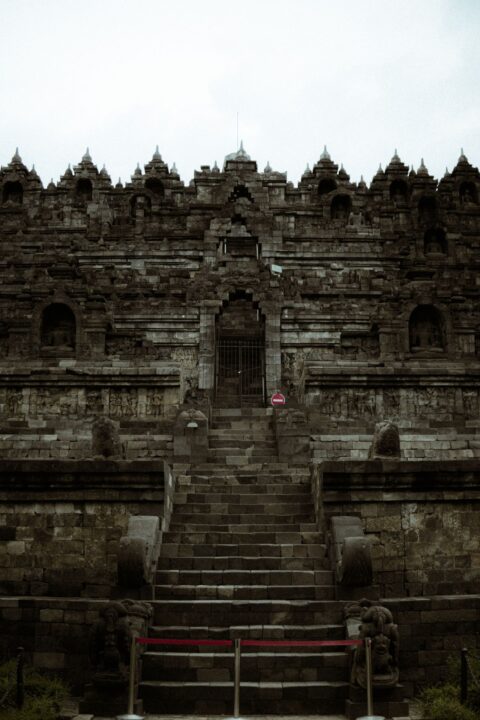
Borobudur isn’t just a stack of stone terraces. It’s a three-dimensional mandala — a physical representation of the Buddhist cosmos that you’re meant to traverse as a form of moving meditation. You start at the base representing the world of desire and, as you climb and circumambulate each level, you move progressively toward enlightenment.
The structure is divided into three cosmological zones.
Kamadhatu – The World of Desire
The lowest level represents the realm of ordinary human existence — desire, passion, and the consequences of worldly attachment. The original relief panels here (called the Mahakarmavibhangha panels) depicted scenes of cause and effect, good and bad karma playing out in everyday life. Most of these are now hidden beneath the base extension added during construction (possibly to stabilise the structure), but 160 panels remain visible at the southeast corner.
Rupadhatu – The World of Form
The middle section comprises five square terraces adorned with the famous narrative relief panels. This is where you’ll spend most of your time, and rightly so. The reliefs here depict the life of the historical Buddha Shakyamuni, stories from the Jataka tales, and the Gandavyuha — a Mahayana Buddhist text about a young man’s spiritual journey. The galleries are designed to be walked clockwise, reading the reliefs from left to right as you proceed.
It’s worth slowing down here. Most visitors walk past the panels too quickly. Look for the musicians, the ocean voyages, the royal court scenes. The craftsmen who carved these were not just illustrating doctrine — they were documenting their world.
Arupadhatu – The Formless Realm
The upper three circular terraces represent the realm beyond form — closer to nirvana, where the material world dissolves. Fittingly, the decoration also dissolves: no more narrative panels, no more ornamentation. Just 72 perforated bell-shaped stupas arranged in concentric circles, each one containing a seated Buddha statue.
The lattice stonework of these stupas is one of Borobudur’s most photographed features. Peer through the diamond-shaped holes and you’ll see a Buddha in dhyana mudra (meditation pose) looking back at you. It’s a genuinely affecting visual, even on a crowded day.
The Central Stupa
At the summit sits the main stupa, 10 metres in diameter, symbolising the absolute — nirvana, the final destination of the spiritual journey. It’s thought to have once contained a Buddha statue, though this remains debated. What’s certain is that the view from the top is extraordinary: volcanoes in every direction, rice paddies and forest stretching to the horizon, the circular terraces cascading below you.
The 72 Perforated Stupas
Each of the 72 latticed stupas on the upper circular terraces contains a single Buddha statue. Traditionally, touching the hand of the hidden Buddha through the lattice was considered auspicious. Current visiting rules restrict this, but the stupas themselves — especially in the golden light of early morning — remain one of the great sights of Asian travel.
The Three Temples of the Borobudur Temple Compounds
Most visitors arrive, see Borobudur, and leave. But the UNESCO designation isn’t just for one monument — it covers the entire compound, which includes two other temples that most people walk straight past.
Borobudur Temple
The main attraction, covered at length above. What’s worth emphasising here is the scale of what you’re dealing with: this is a building the size of a medium hill, covered in more than two thousand relief panels, topped with 72 individual stupas. Budget more time than you think you need.
Mendut Temple
About 3 kilometres east of Borobudur sits Mendut, a smaller but deeply impressive 9th-century temple that most visitors skip entirely. This is a mistake. Inside Mendut’s main chamber sits one of the finest groups of Buddhist statuary in Southeast Asia: three enormous figures — the Dhyani Buddha Vairocana flanked by Avalokitesvara and Vajrapani — carved with extraordinary refinement.
The reliefs on Mendut’s exterior walls also deserve attention, depicting Bodhisattvas and celestial beings with a subtlety and grace that rivals anything at the main monument. It’s quieter, less crowded, and deeply beautiful.
Pawon Temple
Tiny Pawon sits precisely between Borobudur and Mendut on a straight symbolic axis, suggesting all three temples were designed as part of a unified pilgrimage route. The temple itself is small, but its exterior carvings — including the famous Kalpataru (wish-fulfilling tree) panels flanked by dwarfs pouring riches — are intricate and lovely.
The traditional interpretation is that pilgrims would begin at Mendut, purify themselves at Pawon, and then proceed to Borobudur for the full cosmological journey. It’s a narrative that makes the whole compound feel intentional rather than incidental.
Top Things to See at Borobudur
If you’re pressed for time, here’s what to prioritise.
1. The Narrative Relief Panels (Rupadhatu Level) Walk the full circuit of at least the first two gallery levels. Go slowly. The panels reward attention — look for recurring characters, narrative arcs, and moments of unexpected humour and humanity.
2. The 72 Perforated Stupas Spend time on the circular terraces in early morning light. The interplay of stone, sky, and latticed shadow is unlike anything else.
3. The Buddha Statues 504 in total, in various states of completeness. Many are headless (lost to time, earthquakes, and 19th-century collectors), but the intact ones — particularly in the niches of the lower galleries — are remarkable works of devotional art.
4. The Hidden Foot Reliefs Visit the southeast corner of the base to see the 160 exposed Mahakarmavibhangha panels. These are easily missed and often uncrowded, even when the main monument is busy.
5. The Summit View Self-explanatory. Stand at the top, face the volcanoes, and accept that you are somewhere extraordinary.
6. Mendut Temple’s Interior Don’t skip Mendut. The three colossal statues inside its main chamber are among the finest surviving Buddhist sculptures in the world.
How to Visit Borobudur Temple Compounds
Location
Borobudur is located in Magelang Regency, Central Java, roughly 40 kilometres northwest of Yogyakarta. The site address is Jl. Badrawati, Kw. Candi Borobudur, Borobudur, Magelang.
Opening Hours
The main archaeological park is generally open from 6:00 AM to 5:00 PM daily. Sunrise access (typically from around 4:30 AM) requires a separate, more expensive ticket and advance booking. Hours can change for national holidays and special events, so check the official Borobudur Tourism Authority website before you go.
Entrance Fees
Ticket pricing has shifted significantly in recent years and continues to evolve. As of the most recent information available:
Domestic visitors pay considerably less than international tourists. Foreign adult tickets have been priced at around $25 USD for the main temple access, with higher-tier tickets for the full compound including Mendut and Pawon. Sunrise packages are priced separately and typically cost significantly more.
Check current pricing at the official booking portal before your trip, as prices have been adjusted multiple times and online pre-booking is now strongly encouraged.
Climbing Regulations
This is worth knowing before you arrive: climbing to the upper terraces (above the fifth level) now requires wearing a special sarong provided by management, and visitor numbers to the summit are managed to protect the stone. The policy has tightened considerably in recent years to address conservation concerns. Be patient — it’s worth the wait.
Guided Tours
A knowledgeable local guide makes a significant difference at Borobudur. The relief panels are dense with symbolism and narrative, and without context, much of what you’re looking at can feel like beautiful but opaque decoration. Guides can be arranged through your hotel, at the entrance, or through reputable tour operators in Yogyakarta. Half-day guided tours are widely available and genuinely worthwhile.
Dress Code
Shoulders and knees should be covered. Sarongs are available for hire at the entrance if you don’t have appropriate clothing. This is a religious site and an active place of Buddhist practice — dress accordingly.
Accessibility
The uneven stone surfaces and steep staircases make Borobudur challenging for visitors with limited mobility. The lower terraces and exterior grounds are more accessible, but the upper levels involve significant climbing. The surrounding Manohara resort area provides accessible viewing of the monument from ground level.
Best Time to Visit Borobudur
The dry season — roughly May through September — is the optimal window. Skies are clearer, sunrise views are more reliable, and you’re less likely to get caught in a tropical downpour halfway up the terraces.
That said, Indonesia’s weather is not entirely predictable, and the wet season (October through April) has its own appeal: lush vegetation, dramatic cloud formations, and fewer tourist crowds. Just bring waterproofs and accept that your sunrise might be more dramatic than photogenic.
Sunrise visits are best attempted on weekdays. Weekends — and particularly public holidays — bring significantly larger crowds, both domestic and international. If you’re planning a sunrise experience, a Tuesday or Wednesday during the dry season gives you the best odds of a contemplative rather than chaotic experience.
Borobudur Vesak Day (the Buddhist festival commemorating the birth, enlightenment, and passing of the Buddha) is celebrated here with extraordinary ceremony — lanterns, candlelit processions, monks in saffron — and falls in May or June depending on the lunar calendar. If you can time your visit around it, it’s a once-in-a-lifetime spectacle.
How to Get to Borobudur
From Yogyakarta
Yogyakarta is your base, and it’s well-connected. The easiest options are:
- Private driver/hire car: Around 1–1.5 hours from central Yogyakarta (40 km), costs roughly 300,000–500,000 IDR one-way. Book through your hotel or a reputable travel service.
- Organized day tour: Widely available from Yogyakarta, often combining Borobudur with Prambanan or a sunrise visit with a morning temple tour.
- Trans Jogja bus + local bus: Budget option for the adventurous, but time-consuming and involves changes. Fine if you’re not on a tight schedule.
From Jakarta
Jakarta to Yogyakarta is typically done by overnight train (8–9 hours, comfortable executive class available) or a short domestic flight (1 hour). From Yogyakarta, see above.
From Bali
Fly Bali–Yogyakarta (1 hour, multiple daily flights on multiple carriers) or take the tourist bus via the Java ferry crossing if you have time and a sense of adventure. From Yogyakarta, onward to Borobudur as above.
Yogyakarta International Airport (YIA)
The newer Yogyakarta International Airport (YIA) at Kulon Progo is actually closer to Borobudur than the city itself — roughly 35 km. If you’re arriving specifically for Borobudur, consider going directly from the airport rather than routing through the city. Airport transfers can be arranged in advance.
Borobudur Sunrise Experience
Yes, it’s absolutely worth it. No, the logistics aren’t as simple as they used to be.
Sunrise access at Borobudur has been formalised into ticketed programmes, primarily managed through the Manohara Hotel on-site. The standard arrangement involves arriving before dawn, ascending the monument with torches, and watching the sunrise from the upper terraces as the mist lifts and the volcanoes come into view.
The experience is legitimately spectacular when conditions cooperate. The best photography windows are during May–September when clear skies are more reliable. Mount Merapi to the northeast and the Menoreh Hills to the west frame the sunrise in a way that no postcard adequately captures.
Book well in advance, particularly if you’re visiting during peak season or around Vesak. These programmes fill up. Check the Borobudur Tourism Authority and the Manohara Hotel websites for current availability and pricing.
One honest caveat: sunrise visits are popular, and you won’t be alone. If the idea of sharing the moment with dozens of other early risers bothers you, manage your expectations accordingly. But in my experience, the atmosphere at sunrise is still genuinely reverential — people tend to be quiet, watchful, and respectful of the space.
Photography Tips
Borobudur is one of the most photographable places on earth. Here’s how to make the most of it.
Best Photo Spots
- Upper circular terraces at sunrise: The combination of stupas, mist, and volcano backdrop is the classic shot.
- Relief panel close-ups: Get within a metre and fill the frame with the carved stone. The narrative detail rewards macro-style shooting.
- The latticed stupas with Buddha inside: Shoot through the diamond-pattern openings for a layered depth-of-field effect.
- Looking down the terraces: From the summit, shooting down the cascading stacked platforms gives a sense of the monument’s extraordinary scale.
- Mendut Temple interior: The three colossal statues, lit by shafts of natural light from the doorway, are extraordinarily photogenic.
Best Time for Photography
Golden hour is non-negotiable here. Either pay for the sunrise access (worth it) or arrive just as the site opens in the morning. The midday light on stone is harsh and flat. Late afternoon can work, particularly for the warm-toned reliefs on the west-facing galleries.
Overcast days actually work reasonably well for relief panel detail shots — diffused light brings out the carving depth without harsh shadows.
Drone Rules
Drone photography at Borobudur is prohibited in the heritage zone without special permits. The permits are difficult to obtain for individual visitors. Don’t be that person who brings a drone and ruins it for everyone.
Recommended Lenses
- Wide-angle (16–24mm equivalent) for the terraces, stupas, and landscape
- Standard zoom (24–70mm) for general coverage and relief panel context shots
- Telephoto (70–200mm) for compressing the volcanic backdrop and detail shots across the terraces
A polarising filter is genuinely useful for cutting haze on the volcano views.
Nearby Attractions
Don’t leave Central Java having only seen Borobudur. The region is absurdly rich with things worth seeing.
Prambanan Temple Compound — 17th-century Hindu temple complex dedicated to the Trimurti, about 45 km east of Borobudur near Yogyakarta. Also UNESCO World Heritage. Also extraordinary. Doing Borobudur and Prambanan in the same trip is genuinely worthwhile.
Mendut Temple — Already covered above. Three kilometres from Borobudur. Don’t skip it.
Pawon Temple — Also covered above. Small but worth the short detour.
Mount Merapi — The active stratovolcano that dominates the northern skyline is a draw in its own right. Jeep tours to the lava fields and a visit to the Merapi Museum tell the story of this geologically — and historically — significant peak.
Yogyakarta (Jogja) — Your likely base, and a genuinely great city. The Kraton (Sultan’s Palace), the Taman Sari Water Castle, the vibrant Malioboro street market, and some of the best Javanese food in Indonesia make it worth spending at least a couple of days here beyond the temple visits.
Borobudur Temple Facts
For the quick-scan crowd:
- UNESCO World Heritage Site since 1991
- Built during the Syailendra Dynasty, 8th–9th century CE
- Largest Buddhist monument in the world
- Contains 504 Buddha statues
- Features over 2,500 sq metres of narrative stone relief
- Comprises 72 latticed stupas on the upper circular terraces
- 2,672 individual relief panels, which would stretch ~6 km end to end
- Built from volcanic andesite stone, without mortar
- Took an estimated 75 years to construct
- Restored by UNESCO between 1975 and 1982
- One of the most visited monuments in Southeast Asia
- Part of a three-temple compound with Mendut and Pawon
Frequently Asked Questions
Why is Borobudur famous? Borobudur is the largest Buddhist monument in the world and one of the great architectural achievements of the ancient world. It’s famous for its extraordinary scale, its vast narrative stone relief panels, its symbolic three-dimensional cosmological design, and its dramatic setting in Central Java surrounded by active volcanoes.
How old is Borobudur Temple? Borobudur was built between approximately 750 and 850 CE, making it around 1,200 years old. It was constructed during the Syailendra Dynasty in what is now Central Java, Indonesia.
Can visitors climb Borobudur? Yes, but with restrictions. Visitors can ascend to the upper terraces, including the circular stupa levels and the summit. However, numbers are managed and a special sarong must be worn above a certain level. Climbing directly on the stupas or Buddha statues is strictly prohibited.
How much time do you need at Borobudur? Allow a minimum of three hours for a thorough visit to the main monument — more if you want to include the relief panel galleries in detail. A full day gives you Borobudur plus Mendut and Pawon temples plus time to explore the surrounding grounds.
Is Borobudur worth visiting? Without reservation, yes. It is one of the most remarkable human constructions on earth, in a spectacular natural setting, at a relatively accessible location. The only caveat is managing expectations around crowds — go early, ideally on a weekday, and give yourself time to absorb it properly.
What are the three temples in the Borobudur Temple Compounds? The UNESCO World Heritage property comprises Borobudur Temple (the main monument), Mendut Temple, and Pawon Temple. All three were part of a unified Buddhist pilgrimage route during the Syailendra Dynasty and are aligned on a symbolic axis.
What is the difference between Borobudur and Prambanan? Both are 9th-century UNESCO World Heritage temple complexes in Central Java, but they represent different religious traditions. Borobudur is Buddhist — specifically Mahayana Buddhist — and was built by the Syailendra Dynasty. Prambanan is Hindu, dedicated to the Trimurti (Brahma, Vishnu, Shiva), and built by the rival Sanjaya Dynasty. Visiting both in the same trip gives you a remarkable snapshot of the religious plurality of early medieval Java.
Final Thoughts
There’s a version of this trip where you spend 90 minutes at Borobudur, take a few photos, tick the box, and leave. Plenty of people do that. It’s fine.
But if you give it time — if you walk the galleries slowly, read the reliefs, climb to the summit at dawn, visit Mendut in the quiet of late morning — you’ll leave with something different. Not just a set of photographs but a sense of having encountered something genuinely irreplaceable.
Borobudur was built by people who believed that the path to enlightenment could be physically walked. That you could ascend through the world of desire, through the world of form, to a place of formlessness at the summit. Twelve centuries later, the stones are still there, and the path still makes sense.
That’s worth the early alarm.