

Forget, for a moment, the headline-grabbing passenger counts, because the king of daily takeoffs and landings might just surprise you. It’s a distinction that speaks to the intricate choreography of air traffic control, the strategic importance of geographic location, and the operational philosophies of major airlines.
And the Crown Goes To… Chicago O’Hare (Mostly)!
Drumroll, please… Chicago O’Hare International Airport (ORD)! This Midwestern behemoth consistently vies for, and often outright claims, the title for the most daily aircraft movements. It’s a testament to its strategic positioning and operational efficiency.
We’re talking serious numbers here. In May 2025, ORD recorded a staggering 2,442 daily passenger aircraft movements. Although this fluctuates, the numbers reflect the intense daily operation. This is more than just a statistic; it’s a symphony of coordinated activity, a finely tuned machine operating at near-constant capacity.
Why ORD? A complex interplay of factors. Think of the sheer volume of regional jets crisscrossing the Midwest, coupled with O’Hare’s pivotal role as a mega-hub for both American and United Airlines. Its geographical location makes it a natural connecting point for flights across the continent and beyond.
This is where the plot thickens, where the nuances of measurement reveal a more complex picture. While O’Hare often owns the “flights per day” title, Hartsfield-Jackson Atlanta International Airport (ATL) remains the undisputed heavyweight champion of passenger volume, consistently processing over 100 million passengers annually! It’s a classic case of comparing apples and oranges – a sprint versus a marathon, frequency versus sheer human throughput.
A Look in the Rearview Mirror: When the Skies Shifted
Believe it or not, Chicago O’Hare held the coveted “world’s busiest airport” title for decades, a reign stretching from 1962 until Atlanta finally snatched it away in 1998. This era represents a fascinating period in aviation history, a time when Chicago was the undisputed center of the American aviation universe.
But even before O’Hare’s ascendancy, other airports had their moments in the sun. Chicago Midway, with its pioneering history, and even New York’s Idlewild (now JFK), played crucial roles in shaping the early landscape of air travel. Each airport, in its time, reflected the evolving dynamics of air travel and the changing geographical centers of economic activity.
Since ’98, ATL has largely dominated the passenger charts, a testament to its strategic location and efficient operations. However, the “most movements” crown has been a much tighter race, with ORD often leading in specific daily counts, and ATL recently leading in overall annual movements. The competition is fierce, a constant push and pull reflecting the ever-changing demands of global air travel. Even Guangzhou Baiyun in China has emerged as a contender by daily flights.
Bumpy Air Ahead? The Controversies Plaguing Busiest Hubs
The relentless pace of activity at these busiest hubs comes with its own set of challenges, a series of potential turbulence that threatens smooth operations.
Imagine 13,000 air traffic controllers working without pay, a scenario all too real with the recent government shutdown. This situation led to mandated flight cuts (a staggering 10% at the 40 busiest US airports in November 2025!) and countless delays and cancellations. It’s a stark reminder of the fragility of the system and the human element upon which it relies.
More flights, inevitably, mean more noise pollution, a constant source of stress and potential health risks for nearby residents. The environmental impact extends beyond noise, encompassing increased carbon emissions and ongoing debates about airport expansion. Some airports, like Amsterdam’s Schiphol, are even actively reducing flights to meet ambitious climate targets, signaling a fundamental shift in priorities.
Outdated systems, equipment failures, and the ever-present threat of cyberattacks can bring an entire airport to a grinding halt. We need only recall the recent disruptions at Newark, Delhi, and Heathrow to understand the vulnerability of these complex systems.
And let’s not forget the passenger pain points: overcrowding, interminable security lines, confusing layouts, and the infamous “worst airport food” awards (Newark EWR, we’re looking at you!). These are the daily frustrations that can transform a simple journey into an ordeal.
Future Flight Path: Smart Airports and Sustainable Skies
Despite these challenges, the future of air travel is poised for significant growth and transformation.
Global air travel demand is soaring, with projections estimating nearly 10 billion passengers in 2025 and a staggering 13 billion by 2030. Airports are scrambling to adapt, to expand capacity, and to implement innovative technologies to manage this unprecedented surge in demand.
The rise of the “smart airport” is upon us, promising a more efficient, seamless, and personalized travel experience.
Artificial intelligence and data analytics are optimizing everything from flight paths to baggage handling, promising to reduce delays and improve resource allocation. Biometric technologies, such as facial recognition, are streamlining check-in, security, and boarding, eliminating the need to fumble for passports and boarding passes. Self-driving luggage carts and automated bag drops are already becoming a reality, and advanced security systems, utilizing CT scanners and AI, will make security checks faster and less intrusive.
The aviation industry is increasingly committed to sustainability, pushing for net-zero carbon emissions by 2050. This ambitious goal is being pursued through the development and deployment of Sustainable Aviation Fuels (SAFs), the exploration of electric and hydrogen-powered aircraft, and the implementation of smarter airport operations.
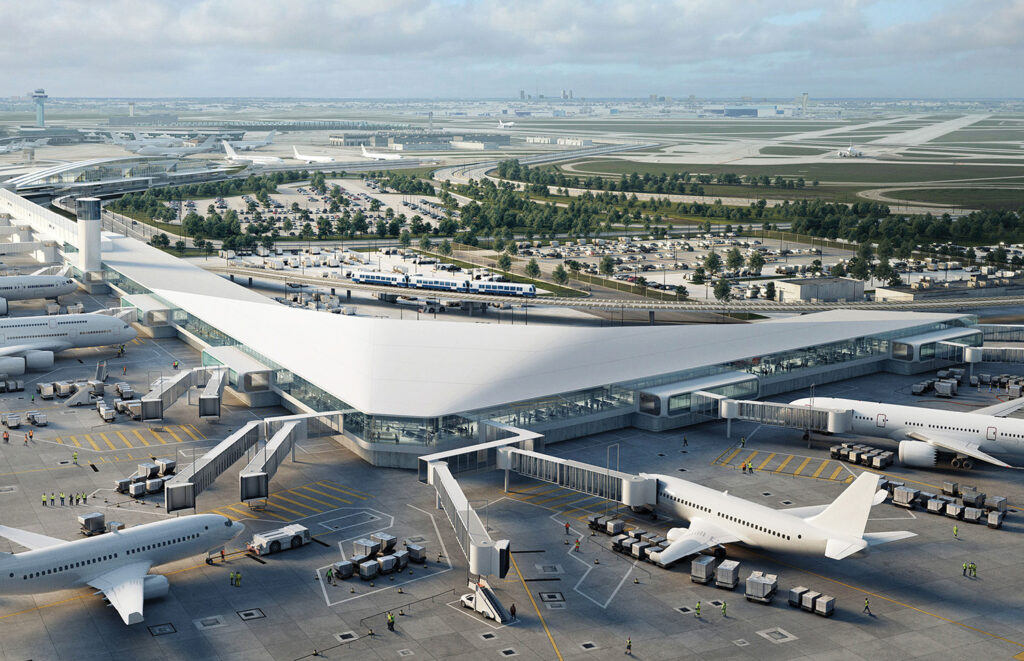
Mega-expansions are underway at airports around the world, from Dubai World and Chicago O’Hare’s ambitious $12.1 billion facelift to JFK, Singapore Changi, and new giants in India and Saudi Arabia. These projects represent massive investments in infrastructure, designed to accommodate the growing demand for air travel and to enhance the passenger experience.
Despite these advancements, significant challenges remain. Workforce shortages, particularly among pilots and air traffic controllers, pose a threat to future growth. Cybersecurity vulnerabilities remain a constant concern, and the ever-present threat of congestion looms large.
The Never-Ending Dance of the Skies
The “busiest airport” title is a dynamic and elusive one, constantly shifting under the influence of technological advancements, global events, and the relentless increase in air travel demand.
While Atlanta may ferry the most people, a testament to its strategic importance as a passenger hub, O’Hare’s skies are often the busiest in terms of sheer flight frequency, a reflection of its vital role in connecting the nation.
From historical shifts to future innovations, the story of the world’s busiest airports is a fascinating snapshot of human ingenuity, ambition, and the occasional (or not-so-occasional) travel headache! It’s a story that continues to unfold, a never-ending dance in the skies.