

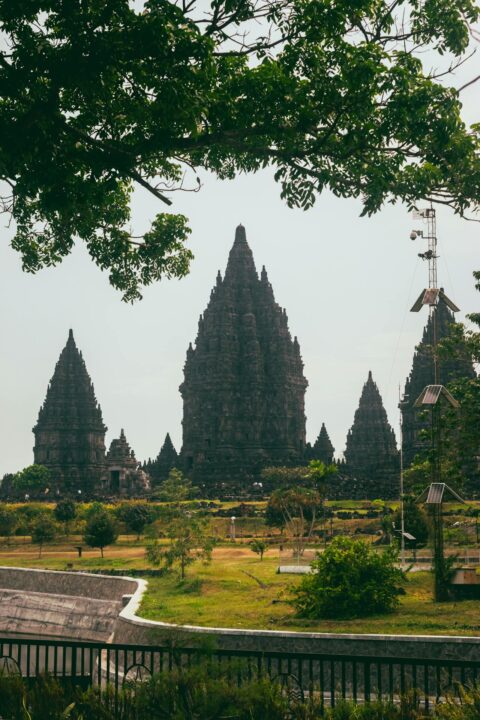
Few places in the world stop you cold in your tracks. Prambanan does. You round a bend in Central Java, and suddenly these razor-sharp stone spires are just there — erupting from the flat plain like something out of a myth. Which, as it turns out, is exactly where they come from.
The Prambanan Temple Compounds are a UNESCO World Heritage Site, a jaw-dropping collection of ancient Hindu and Buddhist temples that together form one of Southeast Asia’s greatest archaeological treasures. They’re also, somehow, chronically underrated compared to their famous neighbor down the road.
Yes, Borobudur gets most of the Instagram attention. We’ll get to that.
Quick Facts
| Fact | Details |
|---|---|
| UNESCO Status | World Heritage Site (inscribed 1991) |
| Location | Central Java & Yogyakarta, Indonesia |
| Built | 8th–10th Century CE |
| Dynasty | Mataram & Sailendra Kingdoms |
| Main Components | Prambanan, Sewu, Lumbung & Bubrah Temples |
| Religion | Hinduism & Buddhism |
| Recommended Visit | Half day (minimum) to full day |
| Nearest City | Yogyakarta |
| Best For | History, architecture, culture, photography |
What Are the Prambanan Temple Compounds?
Here’s where most travel guides get lazy. They say “Prambanan is a Hindu temple complex near Yogyakarta” and leave it at that. That technically isn’t wrong. But it misses almost everything interesting.
The Prambanan Temple Compounds are actually a collection of four separate ancient temple sites clustered together across the border of Central Java and Yogyakarta province. The main site — the towering Hindu complex known as Loro Jonggrang — is the one that gives the whole area its name. But sitting right alongside it are three Buddhist temple complexes: Sewu, Lumbung, and Bubrah.
That’s the part worth pausing on. You have Hindu and Buddhist temples, built by rival kingdoms, sitting peacefully side by side for over a thousand years. Ancient Java, it turns out, was a more religiously pluralistic place than a lot of people assume.
UNESCO recognized the whole complex in 1991, and it remains one of the most significant archaeological sites in all of Southeast Asia.
Outstanding Universal Value: Why UNESCO Listed Prambanan
UNESCO doesn’t hand out World Heritage status because something is pretty. There are criteria — specific, rigorous ones. Prambanan meets two of the most demanding: Criterion (i), which recognizes masterpieces of human creative genius, and Criterion (iv), which identifies outstanding examples of a type of building or architectural ensemble that illustrates significant stages in human history.
In plain language? Prambanan is a masterpiece. Full stop.
The Shiva temple at the center of the Loro Jonggrang complex rises to 47 meters — taller than a 15-story building. The Ramayana relief carvings that wrap around its inner galleries are among the finest examples of narrative stone sculpture anywhere in the ancient world. The entire complex demonstrates a sophisticated cosmological vision translated into physical architecture with extraordinary precision.
And then there’s the broader story: this is a place where two of Asia’s great religious traditions — Hinduism and Buddhism — existed in architectural dialogue, built by different dynasties but occupying the same sacred landscape. That alone would make it exceptional. The fact that it’s also staggeringly beautiful seals the deal.
A Brief History of Prambanan: From Sacred Capital to Jungle Ruin
Origins in the 9th Century
The story starts around 850 CE, during a period when Central Java was one of the most culturally and economically vibrant places on earth. The Mataram Kingdom — Hindu, powerful, and ambitious — commissioned the construction of what would become the Loro Jonggrang complex to honor the Trimurti: the Hindu trinity of Brahma, Vishnu, and Shiva.
It wasn’t a small project. The full compound originally contained 240 temples. Two hundred and forty. Most of those smaller “perwara” or guardian temples are now collapsed, but their stone foundations remain visible in rows, like a ghost city around the surviving central shrines.
The Sailendra Connection
Here’s where it gets interesting. The Buddhist temples at Sewu, Lumbung, and Bubrah were built by the Sailendra Dynasty — rivals of the Mataram Kingdom, Buddhist rather than Hindu. And yet the two complexes exist in close proximity, apparently without conflict.
Some historians believe this reflects intermarriage between the dynasties. Others point to the syncretic religious culture of ancient Java, where Hinduism and Buddhism were less rigidly separated than they later became. Whatever the explanation, the coexistence is remarkable.
Decline, Abandonment, and Rediscovery
Then came the collapse. Around the 10th century, the Mataram court shifted east — possibly due to a volcanic eruption from nearby Mount Merapi, possibly due to political upheaval. The temples were gradually abandoned, and the jungle moved in.
A massive earthquake — or series of earthquakes — in the 16th century caused widespread structural damage and toppled many of the smaller temples. By the time Dutch colonial officials formally documented the site in the early 19th century, Loro Jonggrang was largely in ruins, its stones plundered and scattered by locals repurposing the materials for other buildings.
Systematic restoration began in the 20th century. The main Shiva temple was rebuilt between 1918 and 1953. Work continues today, and modern conservation teams are still reassembling fallen stones using a painstaking anastylosis process — essentially a stone-by-stone jigsaw puzzle.
The Main Components of Prambanan Temple Compounds
Prambanan Temple (Loro Jonggrang)
This is the main event. The Loro Jonggrang complex is the largest Hindu temple site in Indonesia and one of the most impressive in all of Southeast Asia. The name translates roughly to “Slender Virgin” — a reference to a princess in local legend who was cursed into stone by a rejected suitor.
The central zone contains three main shrines:
The Shiva Temple dominates everything. At 47 meters tall, it’s the tallest structure in the compound and houses a four-meter statue of Shiva in the central chamber. Three smaller chambers hold statues of Durga (another name for Shiva’s consort Parvati — and possibly the “Slender Virgin” of legend), Agastya the sage, and Ganesha.
The Vishnu Temple and the Brahma Temple flank it on either side, each around 33 meters high. Together, the three temples represent the Trimurti — the Hindu divine trinity of creation, preservation, and destruction.
Facing these three main shrines are three smaller Vahana temples, each housing the divine “vehicle” of the corresponding god: Nandi the bull for Shiva, Garuda the eagle for Vishnu, and Hamsa the swan for Brahma.
The whole inner zone is ringed by 224 smaller perwara temples — most of them collapsed, but being methodically reconstructed.
Sewu Temple
Sewu deserves way more attention than it gets. Located just north of Loro Jonggrang, Sewu (“a thousand” in Javanese, though the actual count is around 249 structures) is the second-largest Buddhist temple complex in Indonesia, after Borobudur.
Built in the 8th century, probably under Sailendra patronage, Sewu has a distinctive mandala layout with a central main temple surrounded by concentric rows of smaller chapels. The architecture is more restrained than Loro Jonggrang — rounder, softer, more horizontal — but no less impressive.
The Dwarapala statues guarding the entrances are genuinely formidable. These enormous stone guardians, each about two meters tall and wielding clubs, have been watching over the complex for over a thousand years. They look like they mean business.
Lumbung Temple
Lumbung is smaller and quieter, and most visitors walk past it without slowing down. That’s a mistake. This 9th-century Buddhist temple has a central main shrine surrounded by 16 smaller chapels and retains some remarkably well-preserved decorative carvings. If you’re looking for a moment of peace away from the main tourist flow, Lumbung delivers.
Bubrah Temple
Bubrah is the most melancholy of the four. Also Buddhist, also 9th century, it sits slightly apart from the others in a state of ongoing restoration. Large sections of the complex are still disassembled on the ground, stones laid out in rows as conservation teams work to puzzle them back into place. Watching that work in progress — centuries of architectural history slowly being reassembled by hand — is strangely moving.
Architecture and Design: Reading the Temples Like a Text
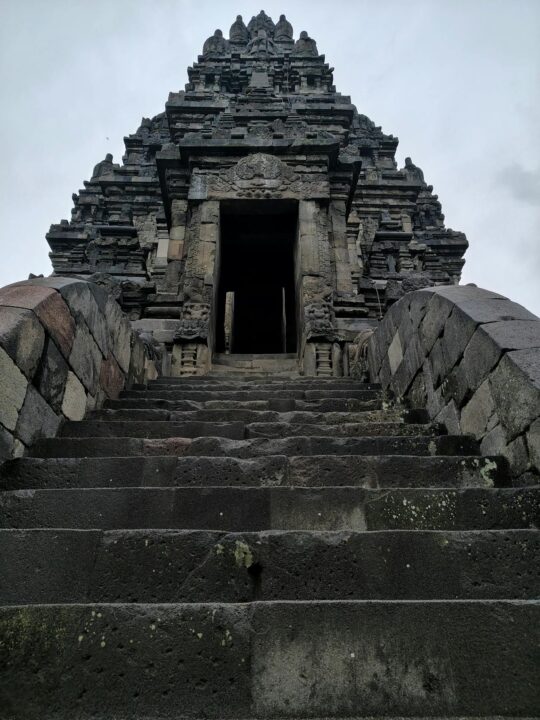
Ancient Hindu and Buddhist temples aren’t decorative. They’re cosmological statements — physical models of the universe as their builders understood it. Once you know what you’re looking at, Prambanan becomes a completely different experience.
Hindu Cosmology in Stone
The layout of Loro Jonggrang mirrors the Hindu cosmos. The central compound represents Mount Meru, the mythological home of the gods at the center of the universe. The outer zones, progressing outward from the inner sanctum, represent the world of humans and then the realm of demons — a three-tiered cosmological hierarchy literally built into the site plan.
The temples themselves are divided vertically into three zones: the base (representing the underworld), the middle (the world of humans), and the upper section (the divine realm). Even the decorative carving shifts accordingly — more earthly motifs at the base, progressively more celestial as you move upward.
The Kala-Makara Motif
Look above every doorway. You’ll see a fierce, bulging face — the Kala head — flanked by serpentine creatures called Makaras. This motif appears on virtually every major temple in the complex and across Southeast Asian Hindu-Buddhist architecture more broadly. Kala is the deity of time and death; his presence above the temple entrance marks the boundary between the mundane world and the sacred space within.
The Ramayana Relief Panels
This is where the temple becomes a book. Wrapped around the inner galleries of the Shiva and Brahma temples is an extraordinary sequential narrative in stone: the Ramayana, one of the two great Hindu epics.
The reliefs run counter-clockwise around the Shiva temple (following the ritual Hindu practice of pradakshina — circumambulating a sacred site with your right hand toward the center), and they’re read from left to right as you walk. Starting with the abduction of Sita by the demon king Ravana and ending with her rescue by the hero Rama and his army of monkeys, the complete story stretches over roughly 100 panels.
The sculptural quality is extraordinary. Individual figures have weight, emotion, and personality. Battle scenes crackle with energy. Animals are rendered with a naturalistic accuracy that feels almost modern. These aren’t symbolic carvings — they’re storytelling.
I’d recommend hiring a local guide specifically to walk you through the Ramayana panels. Without someone explaining the narrative, you’ll appreciate the artistry but miss the story.
The Ramayana Ballet: Where the Ancient Becomes Alive
Here’s something most first-time visitors don’t know. On nights around the full moon from May to October, an open-air performance of the Ramayana Ballet is staged in the grounds of the temple complex itself, with the lit-up spires of Loro Jonggrang as the backdrop.
This isn’t a tourist gimmick. The Ramayana Ballet at Prambanan is a living performance tradition that draws on Javanese classical dance, gamelan music, and wayang (shadow puppet) theatrical conventions. The same story carved in stone on the temple walls is performed live in front of them.
Watching that — the ancient relief narrative animated in front of the monument that inspired it — is one of those rare travel experiences you don’t forget.
Hinduism and Buddhism Side by Side: The Story Nobody Tells Enough
We tend to think of religious traditions as separate, even antagonistic. Prambanan quietly challenges that assumption.
The Hindu Mataram Kingdom and the Buddhist Sailendra Dynasty were political rivals. They controlled different parts of Java at different times, and there is evidence of genuine conflict between them. And yet both dynasties built monumental temple complexes in the same small area, apparently without either side destroying the other’s sacred architecture.
More than that: there’s evidence of genuine cultural exchange. Sculptural motifs appear in both the Hindu and Buddhist temples that suggest shared artistic workshops or at least shared visual languages. Some historians believe the two royal families intermarried, which would explain the peaceful coexistence of their religious monuments.
Whatever the precise history, Prambanan stands as evidence that ancient Java’s religious culture was more complex, tolerant, and pluralistic than tidy narratives allow. That’s worth sitting with.
Practical Visitor Guide
How to Get There
Prambanan is located about 17 kilometers east of central Yogyakarta. Options include:
- Trans-Jogja bus from central Yogyakarta (cheapest, most local experience, about 45 minutes)
- Grab or Go-Jek ride-hailing (convenient, about 30–45 minutes depending on traffic)
- Organized tour from Yogyakarta (common, often combined with Borobudur)
- Rental scooter if you’re comfortable riding in Indonesian traffic (adventurous, fun)
Opening Hours
Generally open daily from 6:30 AM to 5:30 PM, though this can vary. Check the official Taman Wisata Candi website before you go — hours around Ramadan and public holidays sometimes shift.
Entrance Fees
Foreign visitor fees apply and are separate from domestic rates. Combination tickets covering Prambanan, Borobudur, and sometimes Ratu Boko are available and often better value if you’re planning to visit multiple sites. Fees change periodically — verify current pricing when booking.
Best Time to Visit
Get there early. The site opens at 6:30 AM and the light in the first hour is extraordinary — golden, raking across the stone in a way that makes every carving pop. You’ll also beat the heat and the tour bus crowds.
By 10 AM in the dry season, it’s hot. By noon, it’s very hot. Prambanan sits on an exposed plain with limited shade.
Guided Tours
Available at the entrance. A knowledgeable local guide genuinely transforms the experience, especially for the Ramayana relief panels. Arrange in advance through your hotel or a reputable Yogyakarta tour operator for better quality.
Accessibility
The main pathways of Loro Jonggrang are reasonably flat, though the inner compound can involve some uneven stone surfaces. The smaller complexes (Sewu, Bubrah) involve more walking. Wheelchairs are available at the entrance for loan.
Best Things to Do at Prambanan
- Explore the Shiva Temple interior — Enter the main chamber and see the four-meter Shiva statue up close
- Walk the Ramayana Relief Corridor — Follow the epic narrative carved in stone (hire a guide for this)
- Visit Sewu Temple — Don’t skip it; the Dwarapala guardian statues alone are worth the walk
- Watch the Ramayana Ballet — Full moon performances May–October, outdoors with the temple as backdrop
- Photograph sunrise — The site opens at 6:30 AM; the early light on the spires is extraordinary
- Visit Bubrah for a quieter experience — Watch active conservation work on a less-crowded site
- Combine with Ratu Boko — The hilltop palace complex is just 3km south and a stunning sunset venue
Prambanan vs. Borobudur: The Eternal Debate
Every traveler to Central Java eventually asks this question. Which is better — Prambanan or Borobudur? It’s the wrong question, but it’s irresistible, so let’s just deal with it.
| Feature | Prambanan | Borobudur |
|---|---|---|
| Religion | Hindu | Buddhist |
| Century Built | 9th–10th CE | 8th–9th CE |
| UNESCO Status | Yes (1991) | Yes (1991) |
| Scale | Sprawling complex, multiple sites | Single monumental stupa |
| Architecture | Soaring vertical spires | Broad, layered horizontal form |
| Narrative Art | Ramayana reliefs | Buddhist cosmological reliefs |
| Best For | Hindu art, drama, detail | Buddhist heritage, panoramic views |
| Crowds | Significant, but manageable | Often heavier |
| Atmosphere | Dynamic, complex | Meditative, expansive |
My honest take? Borobudur has the more immediately overwhelming scale. Standing on its upper terrace looking out over the volcanic plain is a singular experience. But Prambanan has more drama — those spires, that narrative art, the Ramayana Ballet, the Hindu-Buddhist story. It rewards curiosity more.
Go to both. They’re 40 kilometers apart. There’s no reason to choose.
Best Time to Visit Prambanan
Dry Season (May–October)
This is peak visiting season, and for good reason. Clear skies mean reliable photography, the Ramayana Ballet runs its outdoor program, and the heat is intense but manageable with early starts and water. May and September hit the sweet spot of good weather and slightly lighter crowds before and after the main July–August holiday rush.
Wet Season (November–April)
The site is quieter and greener — the surrounding landscape is lush rather than parched. Rain typically comes in afternoon downpours rather than all-day drizzle, so early morning visits are still very workable. The tradeoff is cloud cover and the cancellation of outdoor Ramayana Ballet performances.
Sunrise Visits
Arrive right at opening (6:30 AM). The light is gold, the stone glows, and you’ll have the compound largely to yourself for the first hour. The air is also dramatically cooler than the afternoon.
Sunset
Prambanan closes at 5:30 PM, so you won’t catch a full sunset at the main site. For that, head to Ratu Boko hilltop palace nearby, which is one of the great sunset views in Java.
Photography Tips
Prambanan is genuinely one of the most photogenic places on earth. Here’s how not to waste it.
- Shoot from the northwest at sunrise — The warm light catches the full face of the Shiva temple with almost no shadow
- Use the Brahma and Vishnu temples as foreground framing — Stand between them facing Shiva for a compressed telephoto shot that shows all three together
- Go low for the spires — Get down near ground level and shoot upward; the vertical lines are extraordinary
- The Ramayana reliefs need patience — Shoot in soft side-light (early morning or late afternoon) to make the carvings pop; direct overhead light flattens them
- Sewu for drone shots — The mandala layout of Sewu is staggering from above if drones are permitted on the day you visit (check regulations, which change)
- Don’t sleep on Bubrah — The disassembled stones and active restoration make for compelling, unusual photographs
Nearby Attractions
Prambanan doesn’t sit in isolation. The surrounding area is one of the richest archaeological regions in Southeast Asia.
Borobudur Temple Compounds — The world’s largest Buddhist monument, 40km west near Magelang. Together with Prambanan, it makes for one of the world’s great two-site day trips.
Ratu Boko — A hilltop royal palace complex 3km south of Prambanan. Partly Hindu, partly Buddhist, architecturally hybrid and hauntingly beautiful. One of the best sunset spots in Java.
Kraton Yogyakarta — The still-active royal palace of the Yogyakarta Sultanate in the heart of the city, with its own fascinating living cultural traditions.
Mount Merapi — The active volcano that has loomed over Prambanan for its entire history. Day trips and morning treks available from Yogyakarta.
Malioboro Street — Yogyakarta’s famous shopping boulevard for batik, silver work, wayang puppets, and the full sensory chaos of Javanese street culture.
Frequently Asked Questions
Why is Prambanan famous? Prambanan is the largest Hindu temple complex in Indonesia and one of the finest examples of Hindu architecture in Southeast Asia. It’s famous for its extraordinary towering spires, intricate Ramayana relief carvings, and the unique coexistence of Hindu and Buddhist monuments within the same archaeological park.
Is Prambanan Hindu or Buddhist? Both. The main Loro Jonggrang complex is Hindu (dedicated to the Trimurti of Shiva, Vishnu, and Brahma). The surrounding compounds of Sewu, Lumbung, and Bubrah are Buddhist. Together they represent the remarkable religious pluralism of ancient Java.
How many temples are in Prambanan? The Loro Jonggrang compound alone originally contained 240 structures, though most of the smaller perwara temples are now collapsed and under restoration. The full Prambanan Temple Compounds archaeological area includes hundreds more across the four main sites.
How much time is needed to visit? Minimum half a day for Loro Jonggrang alone. A full day comfortably covers all four sites. If you’re adding Ratu Boko for sunset, budget the whole day.
Can you visit Prambanan and Borobudur in one day? Yes, and people do it regularly. Most organized tours combine both. That said, you’ll be covering a lot of ground and doing each site at a fairly brisk pace. If your schedule allows, splitting them into separate mornings gives each site the attention it deserves.
Why is Prambanan a UNESCO World Heritage Site? UNESCO listed the Prambanan Temple Compounds in 1991 under criteria (i) and (iv) — recognizing the complex as a masterpiece of human creative genius and an outstanding example of Hindu architecture representing a significant stage in human history.
What are the Ramayana reliefs? A series of approximately 100 carved stone panels wrapped around the inner galleries of the Shiva and Brahma temples, depicting the full narrative of the Ramayana — one of Hinduism’s great epics. They follow the hero Rama’s quest to rescue his wife Sita from the demon king Ravana, with the help of the monkey general Hanuman. The sculptural quality is considered among the finest in the ancient world.
What is the Ramayana Ballet at Prambanan? An open-air classical Javanese performance of the Ramayana story, held on nights around the full moon from May to October in the temple grounds, with Loro Jonggrang as the backdrop. Combines Javanese classical dance, gamelan music, and dramatic narrative. One of the most memorable performance experiences in Indonesia.
Prambanan is the kind of place that recalibrates your sense of what human beings are capable of. Built over a thousand years ago by two rival dynasties with different religions, different artistic traditions, and different cosmological visions — and yet somehow producing a sacred landscape of extraordinary coherence and beauty — it resists easy summary.
It’s not just a tourist site. It’s an argument in stone: for human creativity, for religious coexistence, for the ambition of ancient civilizations that we still don’t fully understand. The Ramayana reliefs alone would justify a flight to Yogyakarta. The rest is just extraordinary bonus.
Go early. Hire a guide. Stay for the Ballet if you can. And give Sewu the time it deserves.
You won’t regret any of it.